
In humans and mice, most genes are expressed from both parental alleles. By contrast, imprinted genes are preferentially expressed from either the maternal or the paternal allele, some with a maternal-to-paternal ratio that varies depending on the tissue. Imbalances in the expression levels of imprinted genes are associated with numerous developmental diseases.
At the imprinted Mest/Copg2 locus (which is implicated in neurodevelopmental diseases), Copg2 is biallelic in all tissues except the brain, where it is maternal. The Copg2 antisense gene, Mest, is expressed exclusively from the paternal allele. In the brain, Mest RNA appears as a long isoform known as Mest-XL, so long that it extends into the transcriptional territory of Copg2. The underlying mechanisms are not well understood, but the prevailing hypothesis is that Mest-XL collides with the Copg2 RNA being transcribed in the opposite direction. Hence, paternal Copg2 RNA becomes destabilised. Thus, Copg2 is expressed solely from the maternal allele.
When the work presented here began, several questions remained unanswered: do brain organoids reproduce the gene regulation of Mest/Copg2 in vivo? Does Mest-XL result from the lengthening of Mest? When does Mest-XL appear? Is Mest-XL required for silencing paternal Copg2? Are there other factors driving the maternal expression of Copg2?
This issue was addressed by a collaborative effort led by Philippe Arnaud and Franck Court (iGRED), and Tristan Bouschet at the IGF (team “Functional genomics of imprinted genes” led by Laurent Journot), involving two PhD students (Anne-Charlotte Fromaget and Nuttamonpat Gumpangseth), Céline Lemmers (PVM), Davide Normanno and Floric Slimani (Edouard Bertrand’s laboratory, IGH), a Canadian laboratory (Louis Lefebvre, University of British Columbia, Vancouver), and a Japanese laboratory (Kazuhiko Nakabayashi, Department of Maternal-Fetal Biology, Tokyo).
To achieve this, the teams used brain organoids generated from mouse embryonic stem cells, tissues from knockout mice, lentiviruses, genetic engineering techniques (CRISPR) to suppress the expression or lengthening of Mest into Mest-XL, and high-resolution gene expression analysis techniques (RNA-seq, sequential RNA-FISH, and chromatin interaction capture).
They observed that:
- Mouse brain organoids recapitulate in vivo brain gene expression at the Mest/Copg2 locus.
- Mest-XL appears during neurodevelopment, concomitantly with neurogenesis.
- Mest-XL is the product of Mest lengthening.
- Mest-XL controls Copg2 expression.
- An additional mechanism involving an enhancer and chromatin conformation controls Copg2 expression.
This study highlights an unexpected level of complexity in the regulation of imprinted genes during neurodevelopment. It also raises some questions. Why does Mest repress Copg2? Is this cell-type specific? What is the importance of this mechanism in neurodevelopmental disorders linked to the Mest/Copg2 locus?
This work has just been published in the journal Nature Communications.
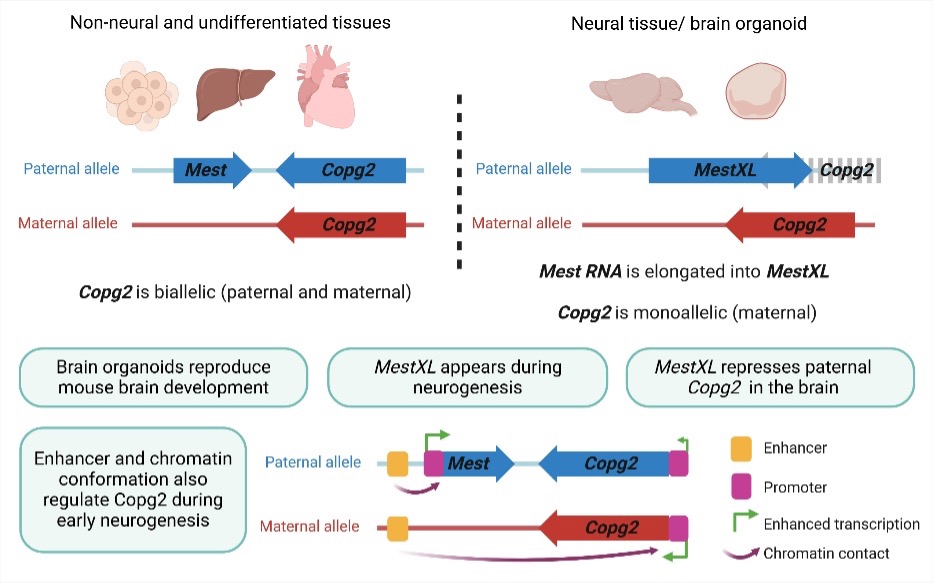
In non-neural and undifferentiated tissues (such as embryonic stem cells), Mest is paternal, and Copg2 is biallelic. In the brain and in organoids generated in vitro from embryonic stem cells, the Mest RNA becomes elongated (referred to as Mest-XL). Mest-XL is so long that it extends into the transcriptional domain of Copg2. Copg2 is then expressed only from the maternal allele. The study by Perillous, Fromaget, et al. shows that it is the elongation of Mest-XL that controls the maternal expression of Copg2. An additional mechanism promotes maternal Copg2 expression at the expense of the paternal allele: the chromatin conformation, which differs between maternal and paternal chromosomes, causes an enhancer (a distant regulatory sequence) to be active only on the maternal chromosome. Figure generated by BioRender.com