
An exceptional case recently reported in Nature Medicine (Llibre-Guerra et al., 2025) described a man, Doug Whitney, carrying a PSEN2 mutation normally associated with the near-systematic development of an early-onset inherited form of Alzheimer’s disease. Yet this patient remained cognitively intact well beyond the usual age of symptom onset, a situation unprecedented to date. Despite a substantial cerebral amyloid burden, he exhibited remarkably restricited tau pathology, an unusual profile associated with preserved cognitive function.
In a commentary published in the Journal of Alzheimer’s Disease, Geoffrey Canet at the IGF (Team “Neuroproteomics and signalling of brain disorders” headed by Philippe Marin) and Emmanuel Planel (Laval University, Québec) put forward an original mechanistic hypothesis: chronic occupational exposure to high temperatures in naval ship engine rooms may have contributed to this resilience by modulating tau proteostasis and clearance. This hypothesis is consistent with a growing body of evidence suggesting beneficial effects of heat on the brain, including epidemiological studies linking regular sauna use with a reduced risk of dementia. Supported by preclinical, clinical, and epidemiological data, this work also drew the attention of New Scientist, which featured these findings and their implications for research on thermoregulation and brain vulnerability during aging.
Altogether, this publication opens new perspectives on the mechanisms of brain resilience and on the therapeutic potential of heat in neurodegenerative diseases.
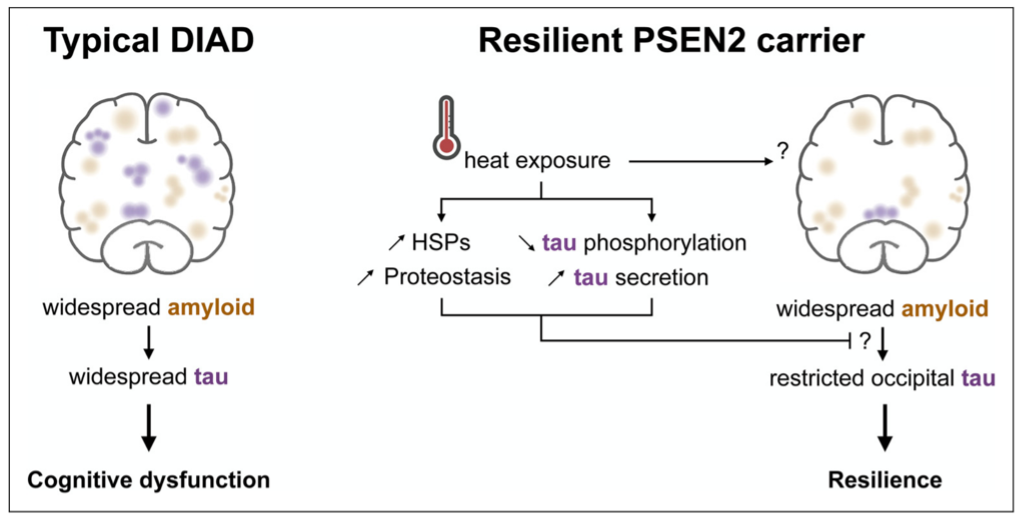
Chronic heat exposure as a potential modulator of tau pathology in DIAD. Unlike typical DIAD cases where amyloid buildup precedes widespread tau propagation and cognitive decline, the resilient PSEN2 mutation carrier described by Llibre-Guerra et al. showed similar amyloid burden but restricted tau deposition (occipital cortex) and preserved cognition. We propose that chronic heat exposure may have enhanced proteostatic mechanisms and modulated tau phosphorylation and secretion, contributing to resilience.