
IDH1-mutant astrocytomas are rare brain tumors that primarily affect young adults and can progress to highly aggressive forms. Their study has been hampered by the lack of serum-free patient-derived cell lines that faithfully recapitulate the biology of these tumors.
Using surgical specimens provided by Prof. Hugues Duffau, the team “Brain plasticity, stem cells and diffuse low-grade gliomas” led by Hugues Duffau and Jean-Philippe Hugnot established four patient-derived cell lines representing different stages of tumor progression. These models were comprehensively characterized using multi-omics approaches.
This work enabled the identification and isolation, by FACS using the CD44 and GLAST markers, of a quiescent or slowly proliferating cell subpopulation. It demonstrated that the emergence and maintenance of this population are regulated by the Notch signaling pathway. These cells exhibit remarkable plasticity, being able to adopt an oligodendrocyte progenitor cell (OPC)-like phenotype before re-entering the cell cycle and resuming proliferation. In addition, DLL3, an antagonist of the Notch pathway, plays a key role in regulating this cellular plasticity and maintaining the quiescent state of these tumor cells.
This unique biobank of patient-derived cell lines represents a valuable resource for the scientific community. It will facilitate the investigation of the genes and signaling pathways involved in the initiation, progression, and cellular plasticity of IDH1-mutant astrocytomas, while providing a robust preclinical platform to evaluate novel therapeutic strategies for these currently incurable brain tumors.
This work has just been published in the journal Acta Neuropathologica Communications.
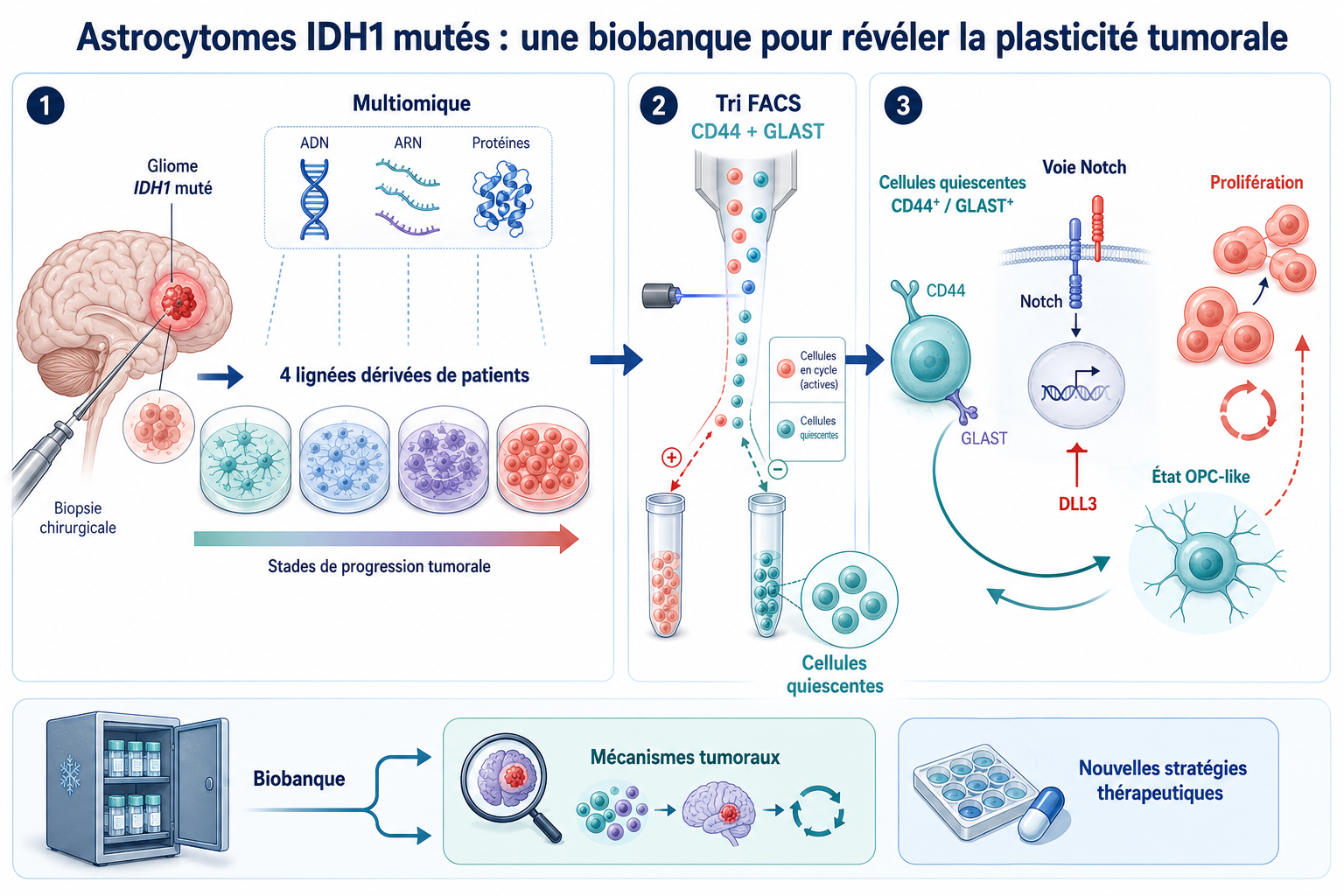
Four cell lines derived from IDH-mutant astrocytomas reproduce molecular and functional features associated with tumor grade. They retain three major cellular states—astrocyte-like, oligodendrocyte-like and NPC-like. In the LGG275 cell line, astrocyte-like cells adopt a quiescent but plastic state that is partly regulated by the NOTCH pathway and its negative regulator DLL3.