
Exposure to certain pesticides appears to be involved in type 2 diabetes and Parkinson’s disease onset which are reported to be epidemiologically associated. While the exact causes of this association and the deleterious mechanisms linking these age-related diseases are not fully known, it seems important to assess the extent to which environmental factors such as pesticides could be involved. The objective of this study, conducted by Safia Costes within the team “Innovative therapeutics for diabetes” co-led by Magalie Ravier and Eric Renard at the IGF, in close collaboration with Thierry Baron (ANSES, Lyon) and Laurence Gamet-Payrastre (Toxalim, Toulouse), was to assess the consequences of chronic dietary exposure to a mixture of pesticides in transgenic mice predisposed to develop motor disorders, and at concentrations below the acceptable daily intake in human.
Male mice expressing mutated A53T human α-synuclein (M83, a Parkinson’s disease model) and wild-type mice were fed either a control or a diet enriched with 6 pesticides (captan, boscalid, chlorpyrifos, thiachloprid, thiofanate, ziram) for 50 weeks. Exposure to pesticides led to body weight gain and insulin resistance in wild-type and M83 mice, caused, at least in part, by a reduction in insulin receptor levels in liver, skeletal muscle and adipose tissue. However, only M83 mice exposed to pesticides showed early motor deficits associated with decreased insulin receptor levels in midbrain and striatum. While pesticides promoted glucose intolerance in wild-type mice, M83 mice surprisingly showed improved glucose tolerance accompanied by a significant increase in pancreatic beta-cell mass and function. Transcriptomic analysis further revealed an enrichment of genes involved in amino-acid metabolism in M83 mouse islets with abundant α-synuclein expression. Overall, exposure to pesticides led to insulin resistance, which can be overcome thanks to a previously unrecognized role of α-synuclein in beta-cell adaptation.
Beyond these findings, the study by Arrar et al. highlights the importance to further evaluate the effects of pesticides in human cell models and humanized mouse models that most closely recapitulate type 2 diabetes and Parkinson’s disease. Indeed, a better understanding of the harmful mechanisms involved in the mutual exacerbation of these two pathologies could provide key insights for developing not only prevention measures but also common therapeutic approaches.
This work has just been published in the journal Molecular Metabolism.
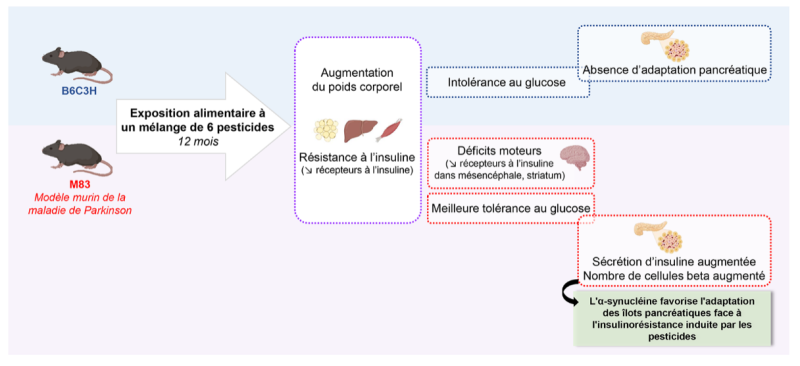
Diagram illustrating the experimental protocol and the main results of the study.