
A study by the team “Brain plasticity, stem cells and diffuse low-grade gliomas“, led by Hugues Duffau et Jean-Philippe Hugnot at the IGF, reveals an unexpected role for endothelin signaling in diffuse gliomas.
Endothelins are small vasoactive peptides mainly produced by vascular cells. They signal through two G protein-coupled receptors, EDNRA and EDNRB. While previous studies had suggested that endothelins promote glioma cell proliferation, this work, based on serum-free patient-derived glioma cell lines, shows instead that activation of EDNRB reduces tumor cell proliferation.
The study further demonstrates that endothelin signaling promotes tumor cell migration and drives cells toward a more mesenchymal-like state, a process known as proneural-to-mesenchymal transition. This transition is associated with increased tumor plasticity and more invasive properties. Mechanistically, the authors identify EDNRB-dependent calcium signaling, activation of the ERK/STAT3 pathways, and apamin-sensitive potassium channels as key components of this response.
These findings highlight the importance of the vascular microenvironment in shaping glioma cell behavior. They suggest that blood vessel-derived signals do not merely support tumor growth, but can also profoundly remodel tumor cell identity and invasive properties.
This study was made possible through collaboration with the team “Neuroreceptors, dynamics and functions” headed by Philippe Rondard at the IGF, a team specializing in the pharmacology of G protein-coupled receptors. It also benefited from the expertise of the Arpège pharmacology platform, coordinated by Laurent Prézeau, as well as the PPM proteomics platform led by Martial Seveno. The entire study was carried out in collaboration with several french and international partners, including Montpellier Hospital, the University of Poitiers, CEA Paris-Saclay, the University of Bourgogne, BioCampus Montpellier, and the Jinfeng Laboratory in Chongqing.
This work has just been published in the journal Molecular Oncology.
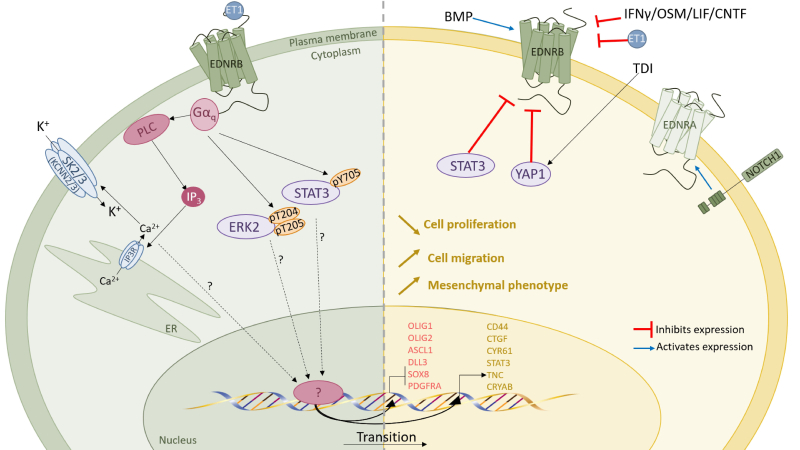
Glioma cells mainly express the endothelin receptor EDNRB, while EDNRA is restricted to a perivascular tumor subpopulation. Endothelin signaling reduces glioma cell proliferation while promoting migration and a proneural-to-mesenchymal transition associated with poor prognosis. This pathway activates Ca2+, K+, ERK, and STAT3 signalings and is regulated by BMP, inflammatory cytokines, Hippo/YAP1, Notch signaling, and hypoxia.