
Animals learn to make good decisions by linking each of their experiences to a positive or negative value. They can also use past experiences to assess a relative value in comparison with the current one. For example, by comparing a current dangerous situation with a previous one, they can determine whether it is “worse or less bad” (relative aversive value). Conversely, by comparing a neutral current situation with a previous dangerous one, they can perceive the current situation as safe (relative safety value). These relative values then help animals select the most appropriate behavior depending on the situation and the choices to be made (for instance, to stay or to flee). However, how the brain learns to make such comparisons remains poorly understood.
The paraventricular nucleus of the thalamus (PVT) is a brain region involved in evaluating the importance and emotional significance of an experience. It could therefore play a key role in learning to distinguish between danger and safety. Magdalena Miranda (postdoctoral researcher) and Elsa Karam (PhD student), together with their collaborators, under the joint supervision of Stéphanie Trouche (team “Appetitive and aversive memory circuits“) and Emmanuel Perisse (team “Neuronal circuits and value coding” at the IGF, developed two new behavioral tasks to observe how mice learn to differentiate relative danger and safety.
The authors found that certain neurons located in the anterior part of the PVT, called D2+ neurons (expressing a dopamine receptor named D2), are active during these types of learning. By manipulating the activity of these neurons, the researchers showed that they are necessary for learning to compare different levels of danger (relative danger), but not for responding to a single, isolated danger (absolute danger, without a prior aversive experience). These neurons also contribute to learning safety, which requires comparison with a previous dangerous experience; indeed, without them, mice spend more time in the safe compartment.
In summary, this research shows that D2+ neurons in the anterior PVT help the brain compare experiences to determine what is more dangerous or safer, thus allowing the selection of the most appropriate behavior for the animal’s survival.
This work was done in collaboration with the “Adenovirus: receptors, trafficking, immunogenicity & vectorology” team led by Eric Kremer lab (Institute of Molecular Genetics of Montpellier, coll Marina Lavigne) and with the help of the Vectorology platform of Montpellier (PVM-IGF, coll Céline Lemmers).
This work has just been published in the journal Current Biology.
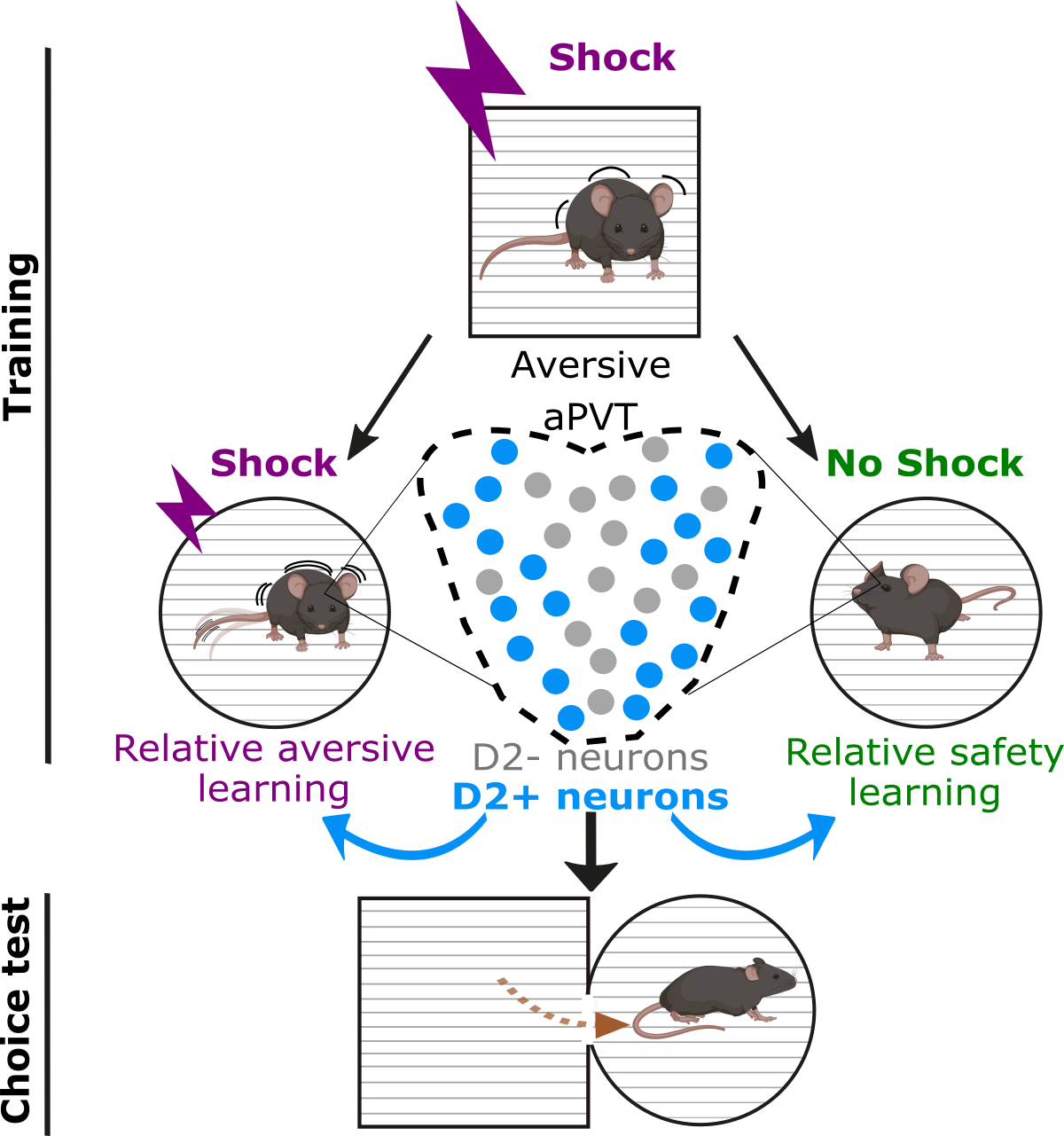
D2⁺, but not D2-, neurons of the anterior paraventricular nucleus of the thalamus are critical for learning relative aversive value and safety to select appropriate value-based choices and defensive behaviors.