
The acceleration of the heart rate by catecholamines, referred to as “chronotropic response”, is a fundamental physiological mechanism to adapt to physical activity, or stressful situations. The chronotropic response is initiated when sympathetically-released or circulating catecholamines activate β-adrenoceptors of heart pacemaker myocytes, stimulating the synthesis of cAMP and activation of cAMP-dependent protein kinase A. However, the electrogenic mechanism mediating the chronotropic response downstream to activated β-adrenoceptors and the role of ion channels in this pathway has been the subject of extensive research and hot debate for the last 40 years, as attempts to abrogate this mechanism by targeting ion channels or exchangers have been unsuccessful.
A study led by Matteo Mangoni’s team (team “Cardioprotection, pathophysiology of cardiac rhythm and ischemia“) at IGF in collaboration with the University of Milan, the Imperial College London and Columbia University now shows that the chronotropic response is generated by two autonomous mechanisms, mediated by L-type Cav1.3 (α1D) channels and hyperpolarisation-activated cAMP-gated HCN channels. The study shows that loss of function of either channel renders the chronotropic response contingent on the functional channel, thereby identifying for the first time “Cav1.3-reliant” and “HCN-reliant” chronotropic mechanisms. The study also identified PKA-dependent regulation of Ras-related Rad protein to Cav1.3 channels as a new key player in the chronotropic response. In summary, this study elucidates the ionic mechanism underlying the positive chronotropic response of heart rate to catecholamines. It identifies, for the first time, Cav1.3 and HCN channels as the key effectors of activated β-adrenoceptors in up-regulation of heart rate, opening the way to a deeper understanding of dysfunction in the chronotropic mechanism of the human heart.
This work has just been published in the journal Circulation Research and is commented in an editorial.
The study is also a highly significant outcome of the Fondation Leducq funded FANTASY network coordinated in Europe by Matteo Mangoni.
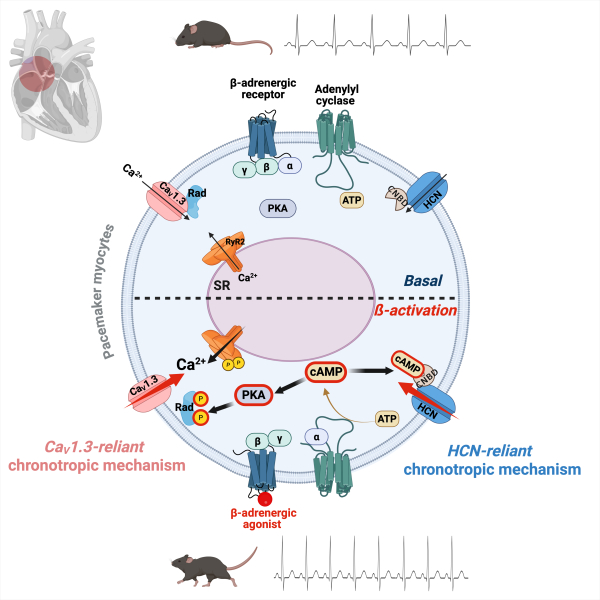
Schematic representation of heart pacemaker cell the mechanism underlying heart rate quickening by catecholamines, referred to as “positive chronotropic response”. At rest (see ECG) the heart beats at relatively low rate, depending on animal’s age, sex and physiological status. β-adrenoceptors are not activated and the concentrations of cAMP and activated PKA are kept relatively low. β-adrenergic activation stimulates cAMP synthesis. cAMP binds to HCN channels to increase the membrane current carried by these channels (HCN-reliant mechanism), while PKA phosphorylates the Cav1.3 partner RAD protein. RAD phosphorylation disinhibits Cav1.3 channels to conduct more Ca2+ current and accelerate heart rate (Cav1.3-reliant mechanism).
Read the publication: https://www.ahajournals.org/doi/10.1161/CIRCRESAHA.125.327497
Read the editorial: https://www.ahajournals.org/doi/10.1161/CIRCRESAHA.125.327778