
A study conducted by Joe McKellar from the team «ARN viruses and host factors» led by Karim Majzoub (IGMM, Montpellier, CNRS/UM), in collaboration with Aurélien Fouillen and Sébastien Granier from the IGF (team «Membrane Protein Structure and Function for Drug Discovery») , reveals how satellite viruses hitchhike.
A satellite virus depends on the coinfection of a host cell with a helper virus for its propagation. At the human level, we know hepatitis D virus, which depends of the hepadnavirus hepatitis B virus surface glycoproteins for infection. This co-infection causes the most severe form of viral hepatitis. On several animals, deltaviruses, that are structurally closed to the hepatitis B virus, have been recently discovered and are also associated to co-infection of different organs.
While we know that helper virus glycoproteins are essential for infection of satellite virus, their association remained unknown. Using integrative and correlative microscopic approaches (EM, AFM, and fluorescence), with infectious assays, the authors observed that deltaviruses are not only borrowing glycoproteins but they directly travel to infect cells via the helper virus, using a Trojan horse’s strategy. Interestingly, once in the cells, the satellite virus can infect and work by itself. This structure function strategy not only show how viruses associate, but also their capacities to perform viral infection.
This work also demonstrated that this infection mechanism is present across multiple species, as rat deltavirus can travel with vesicular stomatitis virus (VSV) in bovines, as well as with herpes simplex virus type 1 in humans, while snake deltavirus can use the snake virus UGV-1 to infect snake cells. This highlight that this propagation mechanism can be used by different species, especially link to some human diseases.
So next time you carpool, watch out for unexpected passengers 🚗🦠
This work has just been published in the journal Cell.
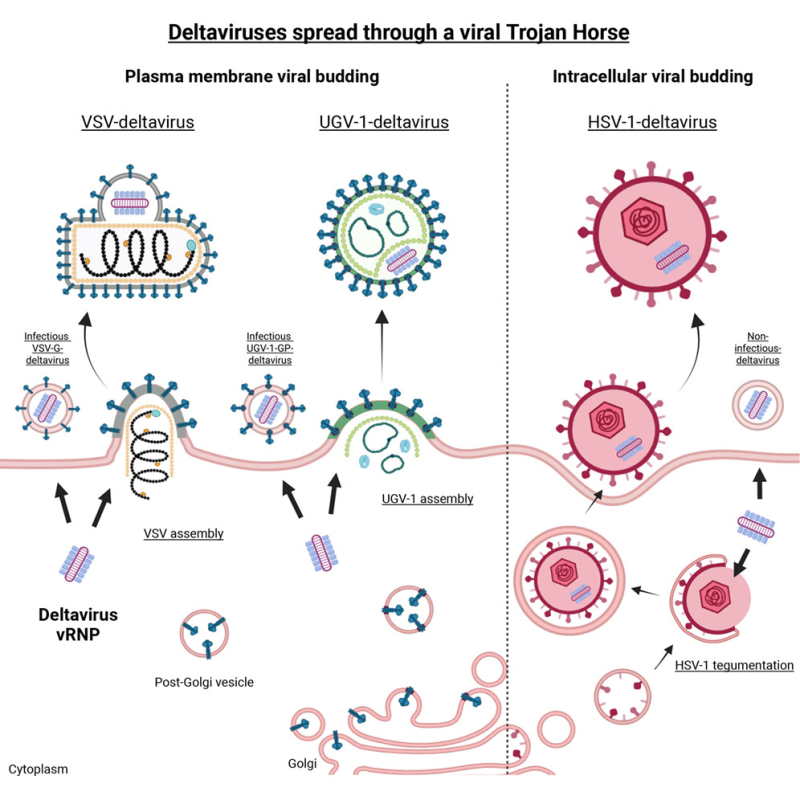
Hepatitis D-like satellite viruses, known as deltaviruses, have been recently discovered in a wide range of animals. These viruses are thought to expropriate glycoproteins from helper viruses to form infectious particles. Here, we challenge this paradigm and demonstrate that deltaviruses are packaged within helper virus particles, using them as viral Trojan Horses for cell entry. We show that this conserved hitchhiking mechanism ensures concomitant deltavirus-helper virus spread, thereby promoting the dissemination of deltaviruses, broadening their host range, and expanding their tropism.