
Chronic stress or dysregulated stress responses are well-established risk factors for the development of neurological disorders such as depression and anxiety. Through the secretion of hormones (catecholamines, primarily epinephrine, and glucocorticoids), the adrenal glands play a key role in the adaptive stress response. It is now well established that the gut microbiota significantly influences emotional and neuroendocrine responses to stress. Extensive data from various preclinical models indicate that the gut microbiota regulates the hypothalamic-pituitary-adrenal axis’s response to acute and chronic stress. In contrast, little attention has been paid to the influence of the gut microbiota on the adrenal medulla, which is responsible for the production and release of catecholamines (the first hormones released in response to stress).
Nathalie Guérineau, in the team “Ion channels in neuronal excitability and diseases” led by Philippe Lory at the IGF, and Sylvie Rabot, in the team “Food, Gut Microbiota, Brain and Metabolic Diseases” team led by Philippe Gérard at the Micalis Institute (INRAE, Jouy-en-Josas), led a study aimed at characterizing the influence of the gut microbiota on the biosynthesis of adrenal hormones, in rats subjected to a period of chronic stress, followed or not by acute stress.
The authors compared the expression of enzymes involved in the biosynthesis of catecholamines (adrenomedullary) and corticosterone (adrenocortical) in conventional (SPF) F344 adult male rats, versus germ-free (GF) rats, some of which were subjected to two weeks of moderate, unpredictable chronic stress, followed or not by acute metabolic stress. While the expression of adrenal cortex enzymes is not drastically altered by stressors, the expression of phenylethanolamine-N-methyltransferase, an adrenal medulla enzyme that catalyzes the conversion of norepinephrine to epinephrine, is significantly increased, specifically in GF rats that underwent chronic and acute stress. In these same animals, the adrenaline content of the adrenal medulla tissue is increased, whereas it is decreased in SPF rats subjected to the same stress conditions.
Furthermore, this study confirmed that chronic stress can alter the composition of the gut microbiota in SPF rats. This effect was accompanied by a disruption of certain metabolic activities of the microbiota, particularly the pathways involved in the biodegradation of carbohydrates, alcohols, and biogenic amines. The potential impact of these changes on intestinal physiology remains to be explored.
In addition to identifying the gut microbiota as a new regulator of adrenal medulla function, this study contributes more broadly to expanding our understanding of the interactions between the peripheral and central pathways involved in the stress response.
This work has just been published in the journal Journal of Neurochemistry.
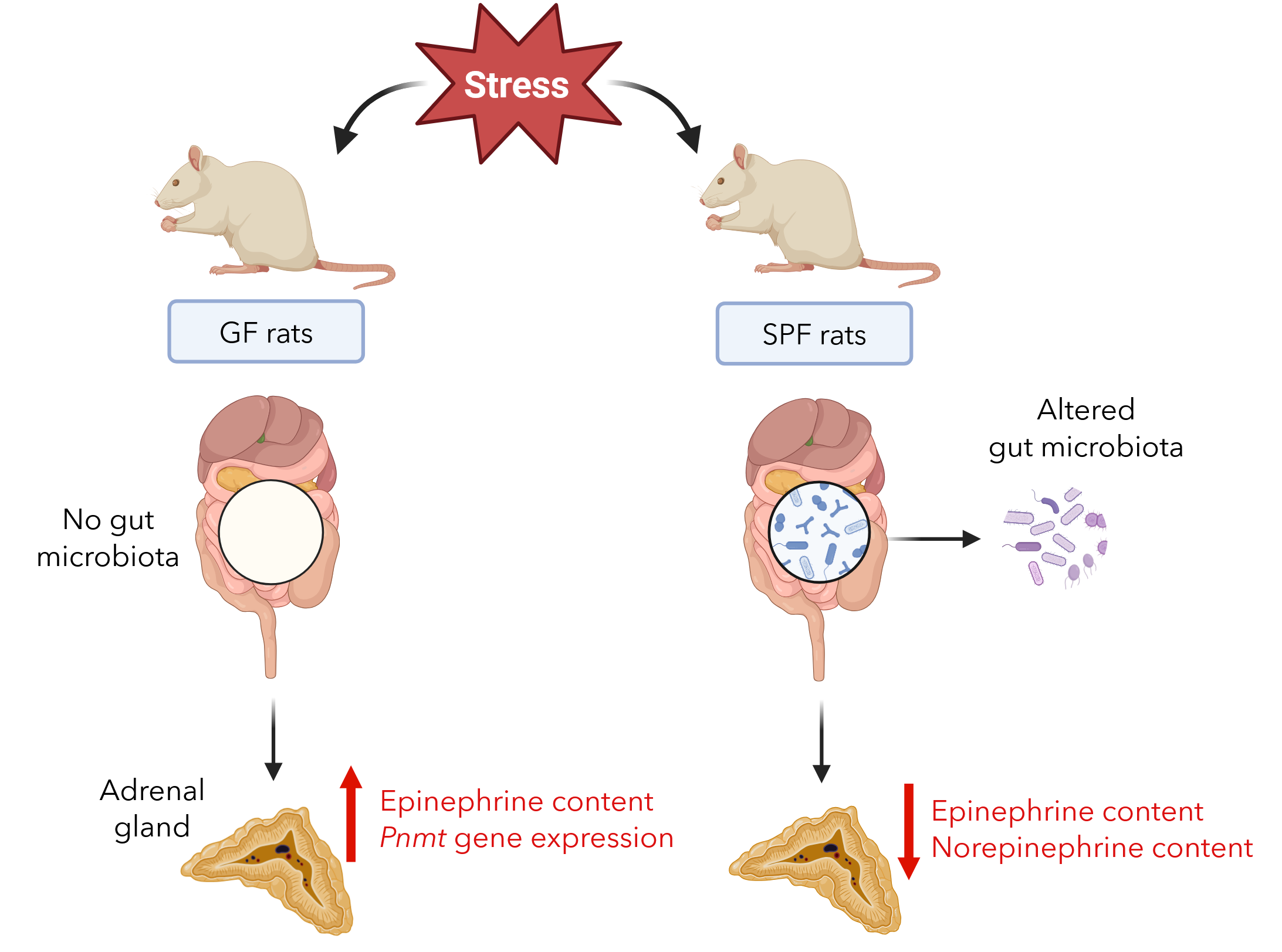
Contribution of the gut microbiota to the regulation of endocrine function in the adrenomedullary tissue: summary of changes related to catecholamines. In stressed rats lacking gut microbiota (GF), stress induces an increase in the expression of the transcript encoding the enzyme responsible for adrenaline synthesis (PNMT), as well as in the intra-adrenal content of adrenaline (epinephrine). In conventional (SPF) rats, stress alters the composition of the gut microbiota, and a decrease in the intra-adrenal levels of adrenaline and noradrenaline (norepinephrine) is observed.