
Does an unexpected failure signal that the rules have changed, or is it just a stroke of bad luck? The brain must constantly resolve this dilemma. Reacting too quickly means mistaking noise for real change; reacting too slowly means getting stuck in habits that have become obsolete. Finding the right balance requires continuously adjusting the rate at which we update our expectations.
Jérémie Naudé (team “Pathophysiology of synaptic transmission” led by Julie Perroy) at the IGF, in collaboration with Etienne Coutureau at the Institute of Cognitive and Integrative Neurosciences of Aquitaine (INCIA, CNRS / University of Bordeaux), shows that shows that norepinephrine released in the orbitofrontal cortex plays this regulatory role. Rats had to choose between two levers associated with complementary reward probabilities that were regularly reversed. Their behavior is not captured by classical models that assume a fixed learning rate: on the contrary, the animals learned faster when rewards were reliable and slower when they were subject to noise.
To account for this flexibility, the authors developed a meta-learning model in which the learning rate is recalculated at each trial based on two internal estimates: stochasticity (the intrinsic noise of the environment, which should slow down the update) and volatility (the probability that the rules have actually changed, which should speed it up). This model finely captures the dynamics of behavior, where fixed-parameter models fail.
This computational model was then used to make experimental predictions. Fiber photometry revealed that norepinephrine release in the orbitofrontal cortex tracks the volatility signal predicted by the model on a trial-by-trial basis: it drops during stable periods and rises immediately after a reversal of contingencies. The model also provided a testable causal prediction: by simulating a “computational lesion” of the volatility → learning rate link, it predicted increased perseveration following reversals, but no deficits during stable phases or under deterministic conditions. Chemogenetic inhibition of the locus coeruleus → orbitofrontal cortex pathway exactly replicated this profile, including the absence of an effect where the model predicted there would be none.
These results identify the LC → OFC noradrenergic pathway as a circuit mechanism that supports the adaptive regulation of learning speed, a function whose dysfunction may contribute to several neuropsychiatric disorders.
This work has just been published in the Proceedings of the National Academy of Sciences (USA).
This work was also highlighted in a CNRS press release.
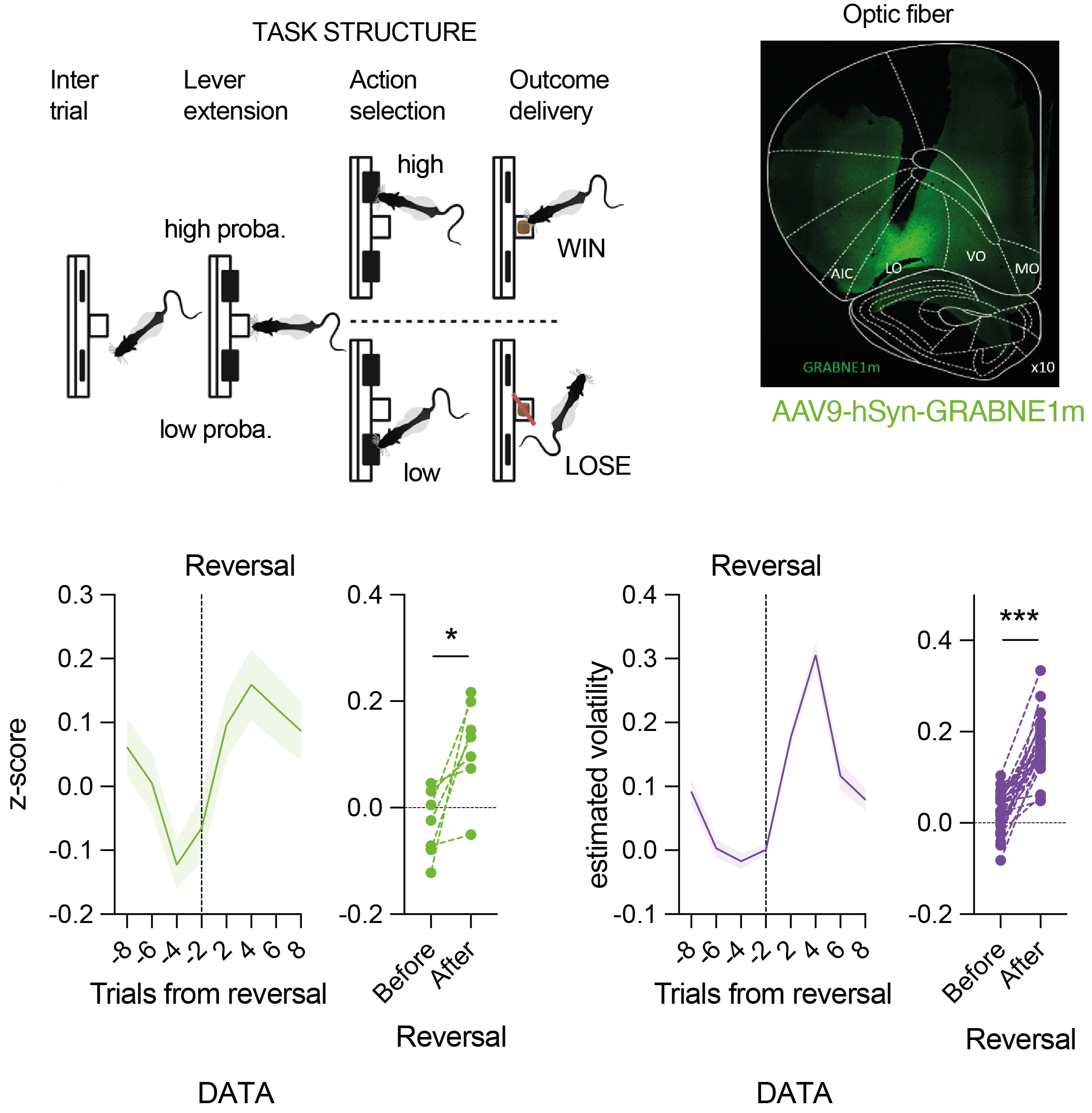
Faced with reward probabilities that periodically reverse, the rat must decide how much to update its expectations after each trial. Noradrenaline released from the locus coeruleus into the orbitofrontal cortex sets this learning-rate dial according to the estimated volatility of the environment, as predicted by the theoretical model.