
A collaboration between the CNRS and WWF-France has led to the recording of the first electrocardiogram of a fin whale in the wild.
An IGF researcher behind this major scientific breakthrough.
For more than four years, Angelo Torrente, researcher in the “Cardioprotection, pathophysiology of cardiac rhythm and ischemia” at IGF has been developing an electrocardiogram (ECG) recording system adapted to the constraints of cetaceans’ aquatic life. In August 2025, during a collaboration between CNRS and WWF, this device enabled a world first: the recording of the first-ever ECG of a fin whale in its natural environment. This achievement is part of WWF-France’s program “Cap Cétacés / Stop Collision”, dedicated to reducing collisions between ships and large cetaceans, which represent the main threat facing fin whales in the Mediterranean Sea.
On board the Blue Panda, WWF’s emblematic sailing vessel, and in collaboration with Denis Ody, head of WWF-France’s Cetacean Program, Angelo Torrente (IGF), together with Aurélie Célérier and Bertrand Bouchard, researchers specialists in cetacean sensory perception at CEFE of Montpellier, successfully equipped a fin whale with a multi-sensor tag integrating an ECG recording device combined with an accelerometer, depth sensor, hydrophone, camera, and GPS. This system recorded for five hours the fin whale’s behavior and the activity of one of the largest hearts on the planet, revealing a rate ranging from 5 to 23 beats per minute.
These recordings also made it possible, for the first time, to distinguish the different phases of a cetacean heartbeat, opening new avenues for exploring autonomic modulation during diving and surfacing phases. In addition, the first behavioral analyses suggest that fin whales react late to approaching vessels, indicating an avoidance behavior poorly adapted to fast-moving boats.
These results open new perspectives for better understanding the physiology and behavior of large cetaceans, assessing the impact of human activities, and strengthening collision-prevention strategies.This research will soon be presented at the major European and worldwide conferences dedicated to cetaceans: the European Cetacean Society (ECS) in Dundee, the Society for Marine Mammalogy (SMM) in Puerto Rico, as well as at the congress of the French Society of Cardiology (SFC) in Lyon.
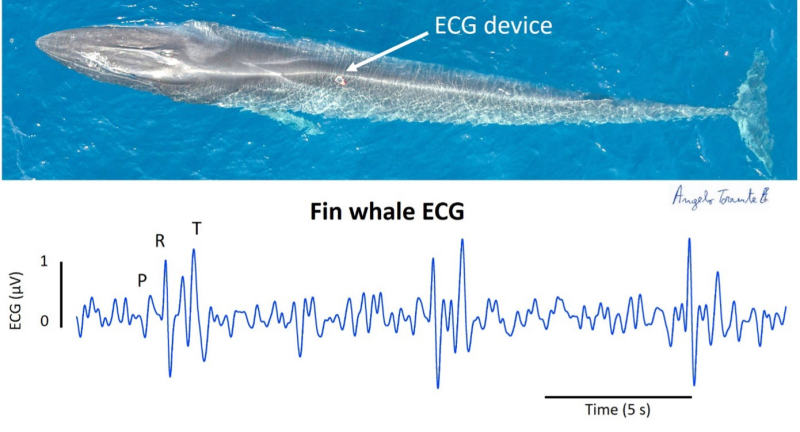
A fin whale fitted with a multisensor tag for ECG recording and an ECG trace (bottom figure) showing the different phases of depolarization and repolarization of the whale’s heart (P, R, and T waves).